
Built for the Rail Boom: GEOWEB Geocells Railroad Resources for Stronger, Longer-Lasting Track
North American railroads are moving heavier freight over longer routes while facing increasing expectations for reliability and network availability. These demands place greater stress on the subgrade and supporting layers beneath the ballast. Soft or variable subgrades, repeated heavy axle loads and erosion or washouts can accelerate track deformation, increasing maintenance costs, slowing orders and ultimately result in costly service disruptions.
For more than 45 years, Presto Geosystems' GEOWEB® 3D Soil Stabilization System has provided rail engineers, contractors, and owners with a proven approach to stabilizing challenging track conditions. This post explores why the GEOWEB Ballast Stabilization System is especially relevant to today’s rail infrastructure demands, where it can provide the greatest value and where to find Presto Geosystems' technical rail resources.
Rail Investment & Connectivity Are Growing
Rail maps are being redrawn, and infrastructure funding is flowing. Three developments stand out:
- CPKC connects Canada, the U.S., and Mexico. Canadian Pacific and Kansas City Southern combined in April 2023 after the Surface Transportation Board (STB) approval, creating the first single-line railway linking all three countries. With a network spanning roughly 20,000 miles, CPKC provides longer single-line hauls mean more traffic, and tonnage on corridors that must stay in service.
- The proposed Union Pacific–Norfolk Southern combination could create the first U.S. transcontinental railroad. The merger is pending and is under review by the Surface Transportation Board (STB), which accepted the revised application on May 28, 2026. Union Pacific has said it expects closing in the second half of 2027, if approved. The proposal would link Union Pacific's western network with Norfolk Southern's eastern network, providing coast-to-coast rail service with a combined footprint of more than 50,000 route miles across 43 states.
- Federal funding is supporting track, bridges, and crossings. The Infrastructure Investment and Jobs Act (IIJA) provides approximately $102 billion in rail funding over fiscal years 2022–2026. The program directs substantial investment towards aging rail infrastructure including track, bridges, grade crossings, and other critical improvements. The FRA's FY25–26 CRISI funding round alone made more than $2.3 billion available for projects that improve the safety, efficiency, and reliability of freight and passenger rail.
More connectivity and more investment bring heavier traffic, tighter maintenance windows, and higher expectations for track performance. Soil stabilization at the points of greatest stress becomes a critical part of that picture.
Key Rail Applications Using the GEOWEB® System
Ballast Stabilization
Heavy axle loads can take a significant toll on track built over soft subgrades. Repeated loading can lead to ballast deformation, differential settlement, pumping, contamination, and loss of track geometry, ultimately contributing to speed restrictions and repeated tamping. The GEOWEB system addresses the problem by confining the sub-ballast in a 3D cellular structure, creating a stiffer, more stable support layer. Confinement improves load distribution and reduces stress transferred to the subgrade.
- Proven under heavy loads. In 2.5 years of under-track testing at the AAR TTCI Facility for Accelerated Service Testing (FAST) in Pueblo, Colorado, GEOWEB-reinforced track extended the tamping cycle to 200 million gross tons (MGT) compared to 15 MGT for unreinforced track. This represents more than 14 times the accumulated gross loading between tamping cycles.
- Less material. By confining aggregate within the 3D cellular structure, the GEOWEB system can reduce cross-section thickness by up to 50% while allowing the use of smaller or more economical aggregate. This can reduce excavation, aggregate quantities, hauling requirements, and overall construction costs.
- Longer ballast life. University of Kansas SmartRock testing demonstrated that GEOWEB-confinement significantly reduces ballast abrasion, movement, and rotation. By limiting particle movement and degradation, the system can help extend ballast life and maintain a more stable track structure.
- Faster installation. The GEOWEB system can be rapidly deployed and installed by a railroad's own crews, making it well-suited for both planned track rehabilitation and time-sensitive repairs. Faster installation helps shorten track outages and minimize disruptions to rail operations.
Bridge Approaches
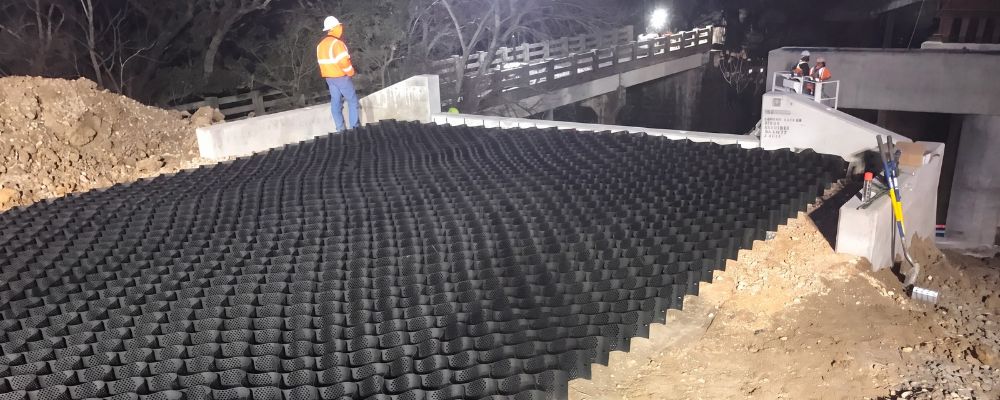
Bridge approaches are among the most demanding transition zones in a track structure. The sudden shift from a rigid bridge abutment to flexible track concentrates dynamic loading and leads to differential settlement and repeated loss of track geometry. The GEOWEB system confines the aggregate foundation, creating a stiffer, more stable layer that smooths the transition in track support while reducing maintenance.
Crossings, Diamonds, and Turnouts
Grade crossings, diamonds, and turnouts require a stable foundation. Repeated impact and complex loading at these locations can accelerate settlement, aggregate movement, and deterioration of track geometry. Repairs are particularly costly because they can disrupt rail operations and—at grade crossings—roadway traffic as well. The GEOWEB system confines the aggregate support layer, creating a stiffer, more stable foundation that helps these critical areas maintain their geometry under repeated loading. The result is greater long-term stability, longer maintenance intervals, and fewer disruptive repair cycles.
Trackside Embankments and Channels
Erosion and washouts can quickly threaten rail operations. Trackside slopes, ballast shoulders, and drainage channels are particularly vulnerable where concentrated runoff, steep grades, or high-flow conditions can remove soil and aggregate. The GEOWEB system confines infill within a three-dimensional cellular structure, helping resist erosion and maintain the integrity of the protected surface. Backed by research and testing at Colorado State University hydraulics laboratory, vegetated topsoil, aggregate, or concrete infill can be selected to match site conditions and hydraulic demands, providing a versatile solution for everything from vegetated embankments to high-flow drainage channels.
Emergency repair readiness. When a washout hits, speed matters. The GEOWEB Geocells Emergency Repair Kit Stocking Program keeps material readily available so local railroad crews can deploy it quickly on track subgrade, right-of-way embankments, bridges and channels.
Why Geocell 3D Confinement?
Unlike planar geogrids and geotextiles, the GEOWEB system confines fill in all directions. Hoop strength and active/passive resistance limit differential and long-term settlement, especially in soft soil. The system deploys in a single step directly over soft soils and suits sites with difficult or limited access. Testing by AAR TTCI, Oregon State University and the University of Kansas supports its performance for ballast reinforcement.
Explore Presto Geosystems' Rail Resources
Whether you are planning new construction or a repair, our rail resources can help you design and specify with confidence. They include:
- Railroad applications overview, covering ballast reinforcement, bridge approaches, crossings, diamonds, intermodal and port stabilization, slopes and channels.
- Mainline ballast reinforcement, with TTCI, Oregon State University and University of Kansas research results.
- Railway embankment and channel protection, including the GEOWEB Emergency Repair Kit Stocking Program.
- The Rail Design + Construction e-binder, plus photos, videos and case studies.
- Complimentary project evaluations, technical presentations, site visits and custom CSI specifications from Presto's engineering team.
Ready to put the GEOWEB system to work on your next rail project? Contact us!
- Visit the Presto Geosystems railroad resources
- Call 800-548-3424
- Request a free project evaluation


