

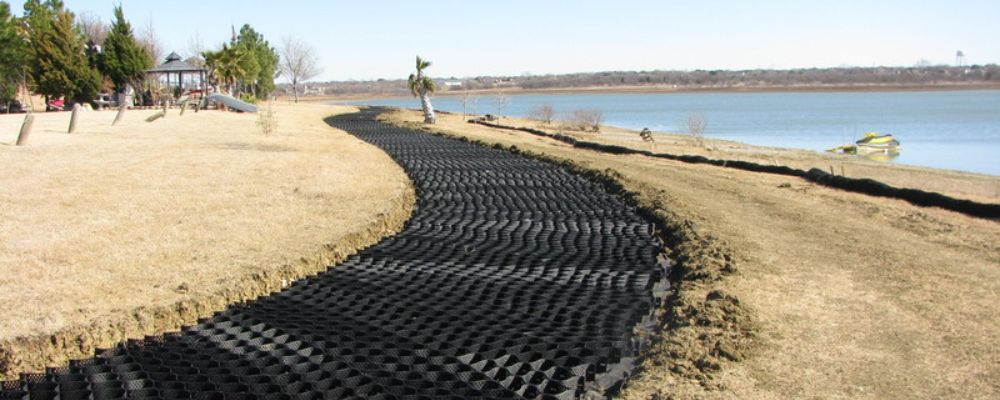
Common Questions About Permeable Recreational Trails Using Ground & Soil Stabilization Systems
In the webinar "Advancing Sustainable Design in Recreational Trails and Embankments," we shared practical strategies for creating trail systems that balance performance, accessibility, and sustainability. Following the presentation, participants submitted a variety of questions about trail construction, permeable pavements, soil stabilization, embankment protection, and building in environmentally sensitive areas. In this Q&A recap, our experts expand on several of those topics and provides additional insights to help designers, engineers, and project owners implement more resilient trail and embankment solutions.
How can hydrostatic uplift be a problem if the system is pervious?
While hydrostatic uplift is rare with pervious systems, it can occur if the subgrade becomes heavily saturated and begins to pump water upward. In cases where reinforcing elements like tendons are not used, this could lead to long-term uplift issues, even with a permeable system.
Is it better to build trails with a level surface, cross slope, or crown?
All three options, level surfaces, cross slopes, or crowned profiles, are acceptable. There is no strict preference, as each can perform well depending on the project design and drainage needs.
Do the GEOWEB cells lose infill over time, creating tripping hazards?
Some infill loss can occur, especially on slopes or after heavy rain events. To minimize tripping hazards, it’s recommended to inspect trails after major storms and refill any exposed areas as needed.
What does the edge treatment look like?
You can use virtually any edging you prefer or none at all. Many projects simply transition the system into the surrounding grade for a natural appearance. Edging is optional and largely aesthetic.
What is the load-bearing capacity of GEOTERRA Mats?
Load-bearing capacity depends on the strength of the subgrade and the expected loads. With those inputs, engineers can determine whether GEOTERRA Mats are suitable for the application.
Can these systems be used near railroads?
Yes, these systems can be used in proximity to railroads. Read case study >>
Is over-excavation or special subgrade preparation required?
That depends entirely on subgrade strength and loading conditions. In some cases, a base layer or additional preparation may be needed, which can be determined through calculations.
Should edges be natural or defined for long-term maintenance?
Many projects opt for natural edges to blend into the environment. For maintenance, vegetation that grows over the GEOWEB system can be managed with routine trimming, such as using a weed whacker.
Can these systems be used on levees?
Yes, they are suitable for use on levees.
How do plastic components interact with the environment over time?
These systems are typically made from HDPE (high-density polyethylene), which does not generate microplastics in this application and can last over 100 years without significant degradation.
What’s the best solution for asphalt over a high-water table?
For asphalt surfaces, GEOWEB Geocells are recommended for base stabilization. GEOPAVE Gravel Pavers are intended for surface applications only. The exact design section will depend on subgrade conditions and loading requirements.
How do you maintain permeability over time?
Maintenance is key. Regularly removing organic debris (like leaves) using a leaf blower helps prevent clogging and preserves permeability.
Can oil or gas infiltration cause groundwater pollution?
Yes, permeable systems can allow contaminants like oil or gasoline to reach groundwater. It’s important to avoid spills and manage potential pollutants carefully.
Is there a maximum slope for road applications?
There isn’t a one-size-fits-all answer. Maximum slope depends on traffic type and project-specific conditions. Our engineering team will be happy to assist with recommendations given project details.
Request a free project evaluation >>
How do tree roots affect these systems?
Tree roots can lift the system over time. If preserving the tree is a priority, some surface deformation may need to be accepted, as preventing root growth would harm the tree.
Does the tan GEOWEB facia have the same UV protection as black?
Yes. Both colors offer equivalent UV resistance, over 100 years, thanks to different UV inhibitors used in manufacturing.
What depth of infill is recommended above the GEOWEB system?
Typically, 1–2 inches of infill are sufficient. The goal is simply to protect the cell walls from exposure over time.
Get started on your next trail project:
We hope the answers provided in this Q&A offer valuable guidance for your future trail and embankment projects. If you would like to learn more about the topics discussed, watch the full webinar on demand and explore additional resources on sustainable trail design and stabilization strategies.
If you have additional questions or would like project-specific guidance, feel free to reach out at info@prestogeo.com. Many of these solutions can be tailored to your unique site conditions.


