

GEOWEB® Geocells Channel Protection Q&A: Real-World Performance Results, Testing Insights & Design Applications
Following our webinar, "Explore Real-World Channel Protection Results with GEOWEB® Geocells", participants submitted questions about hydraulic performance, channel design, erosion control, flow management, and real-world applications. Based on accredited testing conducted at the Colorado State University Hydraulics Lab, this Q&A explores how the GEOWEB Channel Protection System performs in high-flow, steep-slope environments and serves as a sustainable alternative to traditional hard-armoring methods.
Do you have application examples or case studies using live stakes or potted plants?
Yes. We have numerous examples where potted plant material has been successfully incorporated into GEOWEB Geocells. These applications are commonly used in projects that require both erosion control and enhanced vegetation establishment.
View Oyster Point Steep Slope Stabilization >>
Where is the product manufactured?
All of products including accessories are manufactured in the United States and meet the requirements of the Build America, Buy America (BABA) Act.
Are expansion joints required in concrete-filled applications?
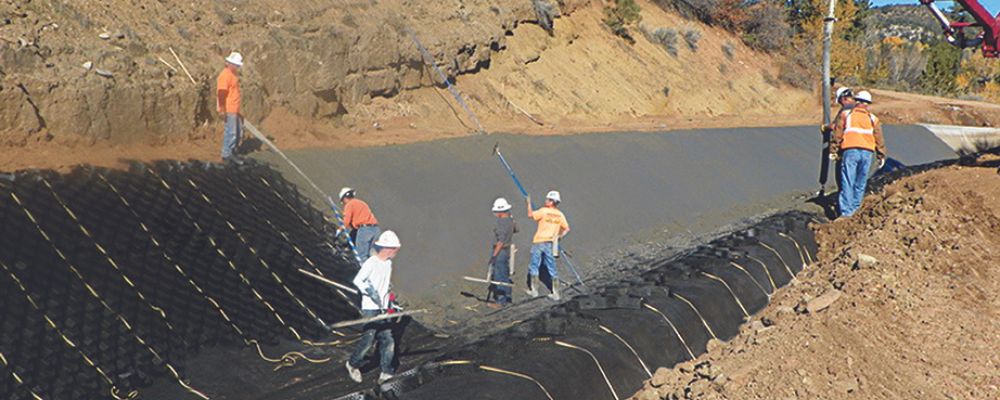
No. Concrete-filled GEOWEB panels do not typically require traditional construction joints within the geocell system because the geocells act as a series of individual confinement cells that naturally control shrinkage cracking and distribute stress.
What concrete specifications do you recommend?
The concrete should be tailored to the application and in accordance with the engineer’s specification. Typical values we see include:
- 3,000 to 4,000 psi compressive strength
- 3-to-5-inch slump as a starting point and adjusted in the field
- 5% to 8% entrained air in colder environments, air may not be required in all applications
However, specifications can vary depending on the slope. Shallower slopes may permit different concrete characteristics than steeper applications.
A common recommendation is to begin with the specified slump and then make field adjustments as needed to ensure the concrete flows properly into the cells.
Can GEOWEB Geocells be used for grade control structures and energy dissipation?
Absolutely. We frequently use GEOWEB Geocells for grade control structures and energy dissipation applications. In fact, we are currently working on multiple projects involving coal ash containment where GEOWEB Geocells is being used for this exact purpose.
How should vegetation requirements influence panel depth selection?
The appropriate GEOWEB Geocells depth often depends on the vegetation requirements of the project.
Available panel depths range from approximately 3 inches to 12 inches. For example, if vegetation requires 6 inches of growing media, we will typically recommend a 6-inch-deep GEOWEB panel.
Because plant selection is highly site-specific, we usually collaborate with local vegetation experts, landscape professionals, and restoration specialists to determine the best solution.
How does the system perform during wildfires or prescribed burns?
We have experience with projects in wildfire-prone regions, including Colorado.
The concrete components are unaffected by wildfire. Since the GEOWEB material is a polymer, exposed portions may experience some surface melting or scarring under extreme heat. However, because much of the system is typically buried, it generally does not sustain significant damage.
Do you provide vegetation specifications?
While we do not typically prescribe specific vegetation mixes, we are happy to work with project teams during the selection process.
For many slope and channel applications, hydroseeding is the preferred method. Local hydroseeding contractors are usually the best resource for determining:
- Seed mixes
- Tackifiers
- Application methods
- Site-specific vegetation recommendations
We often rely on their expertise because they understand local soil conditions, climate, and performance requirements.
For projects involving trees and other larger plantings, the GEOWEB Geocells system can easily accommodate root balls by cutting openings within the panels as needed.
What level of subgrade preparation is required?
The subgrade should generally be reasonably smooth and free of major irregularities.
Minor contours or depressions are usually not a concern. In many installations, a nonwoven geotextile is placed beneath the GEOWEB system. The combined weight of the panel, geotextile, and infill material helps the system conform naturally to minor variations in the ground surface.
Small undulations may be visible on the finished surface, but they typically do not affect performance.
How long does a project evaluation take?
Most project evaluations are completed within one to two business days.
If additional information is needed, our team will typically reach out before that timeframe expires. This may involve:
- Email communication
- Phone discussions
- Brief Teams meetings
Many consultations take only 10 to 15 minutes and allow us to better understand project goals, evaluate alternatives, and recommend the most effective solution.
Sometimes a project that initially appears suited for concrete infill may ultimately benefit from aggregate or vegetation, and vice versa. Early collaboration helps identify the best approach.
Need Help with Your Project?
If you have questions about design, specifications, material selection, or project evaluations, please contact our team. We are always happy to discuss project requirements and help identify the right solution for your application.
Thank you again for attending the presentation. We appreciate your participation and look forward to supporting your future projects.


