

Stormwater Channel Design Q&A: How to Build Resilient, Cost-Effective Channels with GEOWEB® Geocells
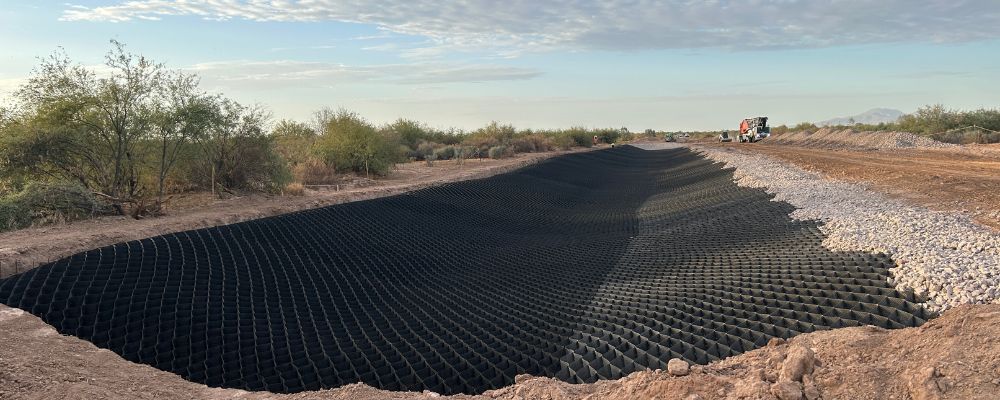
In our recent webinar, "Designing Resilient and Cost-Effective Stormwater Channels", Presto Geosystems' Sam Justice, P.E., answered common questions about channel protection, hydraulic performance, and erosion control strategies. The discussion explored how the GEOWEB® Channel Protection System provides an alternative to traditional riprap solutions, helping engineers and contractors improve channel stability, reduce installation costs, utilize local infill materials, and enhance performance in both low- and high-flow conditions.
This webinar Q&A highlights key takeaways and expert insights to help designers, consultants, and project owners create more durable stormwater infrastructure capable of withstanding demanding hydraulic environments while delivering long-term value.
Can the GEOWEB system incorporate stairs or other site features?
Yes. The GEOWEB system is designed to accommodate a variety of infrastructure elements within a project.
Depending on your application, the system can incorporate:
- Pedestrian stairs built into a slope
- Access steps into or across a channel
- Stepped rapids or transitions as part of a channel design or outfall
- Drive lanes for maintenance or cleanout vehicles
- Fencing
- Guard posts
- Signage
- Other site-specific infrastructure
Every project is different, but integrating these features into a GEOWEB system installation is generally straightforward. If you have a unique application, we're happy to discuss the details or request a free project evaluation.
Can the GEOWEB system stabilize an eroding slope?
Yes, but first it's important to identify the type of slope failure you're experiencing.
There are generally two categories of slope issues:
Surface erosion
If the problem is simply soil being washed away by flowing water, the solution is relatively straightforward. The GEOWEB system is installed directly on the slope surface to confine the infill material and protect the underlying soil from erosion.
Global slope instability
If you're seeing larger failures, such as circular slip failures, mass movement, or deep-seated slope instability, a surface treatment alone is not enough. In these situations, the solution typically involves a reinforced retaining wall or another system with internal reinforcement that extends below the failure plane to stabilize the slope.
The GEOWEB system can be incorporated into both types of solutions, but selecting the appropriate design depends on understanding the underlying cause of the instability.
How thick is the GEOWEB system?
The required panel depth depends on the selected infill material and project conditions. The GEOWEB panels are available in depths ranging from 3 inches to 12 inches.
Typical applications include:
- Concrete infill: 3-4 inches
- Topsoil with vegetation: 4-6 inches
- Stone or other granular infill: 6-8 inches
However, there is no single "standard" thickness.
Final cell depth recommendations depend on factors such as:
- Site conditions and geometry
- Hydraulic loading
- Vehicle traffic
- Pedestrian loads
- Project-specific performance requirements
While design tables can provide general guidance, they cannot account for every project's unique conditions. We provide a free project evaluation service to align project and site needs to the solution details. Projects with unusual loading, hydraulic demands, or site constraints should always be evaluated individually to ensure an appropriate design.
How durable is the GEOWEB system, and what maintenance does it require?
The GEOWEB panels are manufactured from high-density polyethylene (HDPE) with industry-leading structural integrity, system performance, and durability parameters. Our system´s UV stabilizers, high environmental stress crack resistance, resistance to oxidation and weathering, peel strength, and junction efficiency all work together to provide long-term durability in a way that alternative solutions cannot guarantee.
The material is resistant to:
- Ultraviolet exposure
- Oxidation
- Weathering and typical environmental conditions
- High-pH soils
Because HDPE is chemically inert, it does not crack or degrade under normal field conditions. Long-term testing has demonstrated durability for a minimum of 100 years in natural soil with a pH between 4 and 9 and at soil temperatures ≤ 25°.
GEOWEB Geocells Channel Maintenance
Maintenance requirements are minimal and depend primarily on the infill material.
- Vegetated systems: Maintain the vegetation as you normally would, including mowing when needed.
- Aggregate systems: Occasional weed removal may be necessary, but the aggregate generally does not require replacement.
- Concrete systems: Little to no routine maintenance is typically required.
If underground access is ever needed, a section of the GEOWEB system can be removed, the work completed, and a new section connected back into the existing installation using standard connection methods. Although this type of repair is uncommon, the system is designed to allow localized maintenance without reconstructing the entire installation.
Conclusion
Thank you again for joining the webinar and participating in the discussion.
If your question wasn't addressed during the live session, please don't hesitate to reach out. We're always happy to discuss your project by phone or email, review site-specific applications, and help identify the best solution for your needs.


